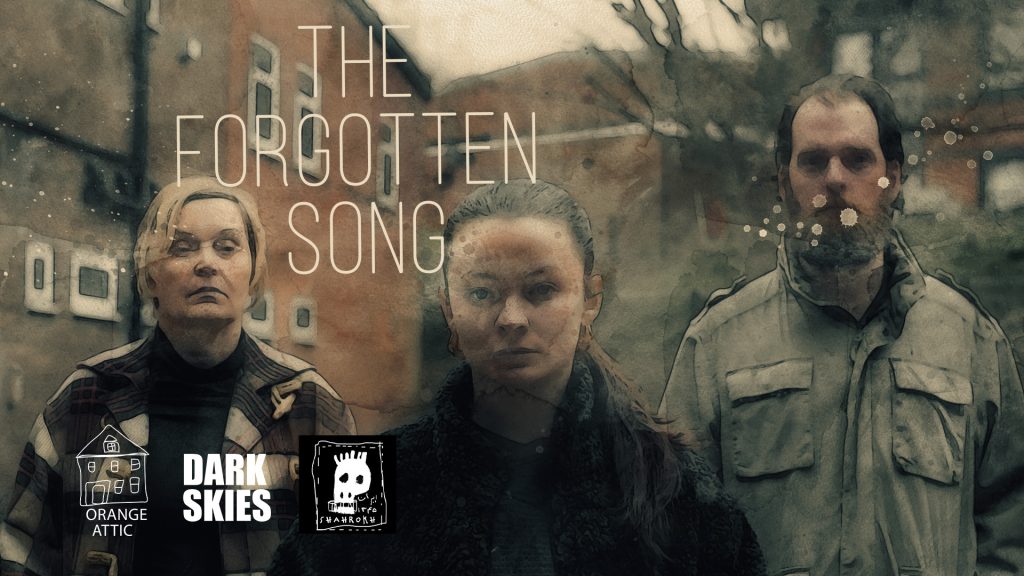
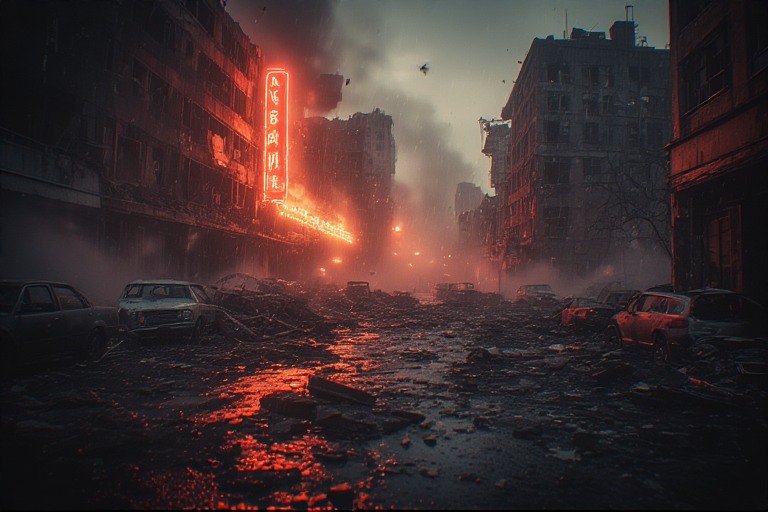
A genre-bending psychological drama set against the backdrop of a collapsing world.
Logline
As a mysterious collapse spreads through the city, a lost woman seeks refuge inside a dance studio with two strangers. As fear and isolation take hold, the boundaries between reality, memory, and the truth she has forgotten begin to unravel.
Synopsis
Amid reports of a city falling into chaos, Lena searches for safety and a way to reach the North Sector Safe Zone. Her journey leads her to an abandoned dance studio, where she encounters Isla, a young dancer waiting for her missing partner, and Ciaran, a frightened stranger claiming the outside world has collapsed.

Trapped together inside the studio, the three struggle to survive as fear, uncertainty, and disturbing events begin to challenge their understanding of what is happening around them. As Lena is drawn deeper into a world where memories and reality appear to collide, she is forced to confront fragments of a past she cannot remember and a truth that may have been hidden from her all along.
Production: 2026
Release Date: Nov 2026
Country of Origin:
United Kingdom
Language:
English
Shooting Format:
Digital

Aspect Ratio:
16.9
Project Type: Short

Runtime:
TBC
Meet the Cast
Mike Peyton
Mike Peyton is an Irish actor from Galway, now based in the UK. He has worked consistently on screen since 2021, bringing a grounded, naturalistic presence to character driven roles. His training includes improvisation, firearms handling, accent work, and British Horse Society Level 1 horse riding.

Fluent in French and Spanish, Mike applies strong language and vocal skills to precise accent work. Alongside acting, he writes, records, and tours original music, shaping a strong sense of rhythm, timing, and screen presence.
Elle O’Donnell
Elle is a Manchester and London based actress, trained at Drama Studio London and The Oxford School of Drama. She works across stage and screen, with a particular focus on character led, contemporary storytelling.

Her recent work includes originating the role of Eve in the new play Outside Voice, directed by Hanna Berrigan at the Soho Poly. On screen, she leads the queer short film Daisy’s Daydream and appears in Cusp, directed by Shahrokh Nael, which has received official selections at US and European film festivals.
Andrea Zapp
Andrea is a Manchester based actress and voiceover artist, originally from Germany. Her work spans short films, independent art projects, and television, with her most recent credit being The Bombing of Pan Am Flight 103 (BBC/Netflix, 2025).

She builds her acting practice on a foundation in Media Arts Performance and Installation, bringing a strong visual and conceptual sensibility to her screen work.
Key Production Team
Director Producer:
Shahrokh Nael

Cinematic Director of Photography:
Chris Forshaw

Senior Production Specialist:
Janine Bardsley

Executive Producer:
Paula Hodgson
Partners & Sponsors
Artistic Interpretation
When the Apocalypse Becomes a State of Mind
There is something inherently unsettling about an apocalypse that refuses to behave like one.

In Dark Skies: Forgotten Song, Shahrokh Nael begins with the familiar grammar of collapse, a city disappearing into uncertainty, strangers searching for safety, rumours of government established safe zones and the growing sense that the world outside is no longer governed by the rules of ordinary life. Yet the film gradually withdraws from the conventions of the apocalyptic thriller, replacing external catastrophe with something far more intimate and psychologically unstable.

The result is a film less interested in asking whether the world is ending than in asking what happens when reality itself becomes difficult to trust.

Lena, a woman moving through the collapsing city, arrives at a dance studio and encounters Isla and Ciaran. Their temporary refuge becomes the film's principal psychological space a place where fear, isolation and uncertainty begin to erode the boundaries between what is happening and what might only be perceived to be happening.

Nael's most distinctive formal decision is the film's movement between genres. Dark Skies initially presents itself through the visual and narrative vocabulary of apocalyptic cinema, before gradually revealing the darker architecture of a psychological mystery. The shift is not merely structural. It changes the audience's relationship with the images themselves.

The film's use of sepia and monochrome reinforces this instability. Rather than functioning simply as a period aesthetic or stylistic embellishment, the restricted palette creates a world that feels psychologically mediated filtered through a consciousness whose relationship with reality is increasingly uncertain. When colour eventually enters the film, its appearance carries a different weight. It is not simply a change in cinematography, but a rupture in perception.

This is where Dark Skies: Forgotten Song becomes particularly intriguing. The film asks the audience to participate in its uncertainty.

Information is withheld, fragments are repeated and apparently familiar situations acquire new meanings as the narrative progresses. Images that initially appear to belong to one genre begin to suggest another. The audience is encouraged to construct an explanation, only to discover that the explanation itself may be unstable.

In this sense, the film belongs to a tradition of psychological cinema in which subjectivity becomes the architecture of the narrative. Reality is not presented as a fixed surface waiting to be revealed, it is something continually negotiated through memory, fear and perception. The dance studio is therefore more than a location. Its emphasis on movement, bodies and repetition creates an interesting counterpoint to the film's psychological concerns. Dance is fundamentally about physical presence the body occupying space while Lena's experience increasingly questions whether experience itself can be trusted. Movement becomes both expression and evidence, while the body becomes a site of memory.

This tension between the physical and the psychological gives the film much of its atmosphere.

Nael's approach to genre is similarly fluid. Rather than treating apocalypse, psychological drama, crime and horror as separate categories, Dark Skies allows them to contaminate one another. The apocalypse provides the external framework; psychological drama provides the interior conflict; mystery controls the release of information; and horror emerges from the possibility that the most frightening threat may not be outside at all.

That refusal to settle comfortably into a single genre is perhaps the film's most defining characteristic. It also explains the significance of the title. The Forgotten Song suggests something remembered imperfectly a fragment whose meaning has been lost, but whose presence remains. The film operates in much the same way. Its images function like fragments of a larger memory, inviting the viewer to assemble them while never guaranteeing that the resulting picture will be complete.

There is a quiet confidence in allowing ambiguity to remain. Rather than providing a conventional explanation for every event, Dark Skies: Forgotten Song places greater emphasis on emotional and visual revelation. The audience is not simply told what has happened, it is gradually confronted with the consequences of what may have happened. The distinction is important. It transforms the film from a puzzle to be solved into a psychological experience to be interpreted.

By the time the film reaches its final movement, the question is no longer simply what happened to the world outside.

The more disturbing question is which world we have actually been watching. That is where Dark Skies: Forgotten Song finds its strongest cinematic identity, in the space between reality and perception, between genre and experimentation, and between what a character remembers and what the audience believes it has witnessed.

The apocalypse, ultimately, may be the least frightening thing in the film. The real darkness lies much closer to home.

Written by Shirin
Date of Publication: 12/09/2026
Berlin-Germany